


Hydrogen Fuel Cell Solutions
Hydrogen as the driving force for mobility and industry
HTWO’s hydrogen fuel cell solutions provide scalable energy solutions for a wide range of applications, from mobility and power generation to heavy equipment, construction machinery, and port equipment.


Real-World Proven
Nearly 30 Years of Expertise, Proven Through Real-World Deployment
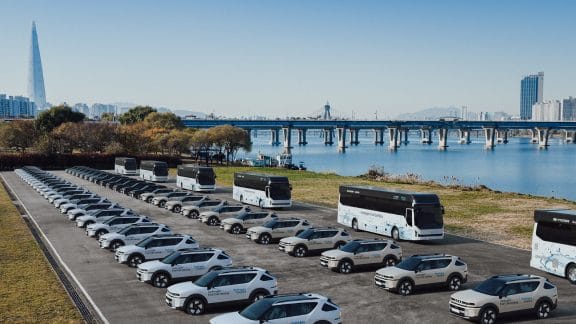
At the heart of Hyundai’s global leadership in hydrogen mobility lies nearly 30 years of continuous investment in technology and research and development, along with hydrogen fuel cell technology proven for its durability and reliability through the real-world operation of approximately 54,000 hydrogen-powered vehicles worldwide (as of August 2026).
HTWO’s hydrogen fuel cell solutions are expanding beyond mobility into a wide range of industries and everyday applications, including power generation, logistics, construction, and marine transportation. Building on the core technologies that have driven the hydrogen mobility era, HTWO is now advancing the hydrogen economy.

Versatility
Diverse Applications and Product Lineup
Hyundai supplies fuel cell systems to a wide range of sectors, including power generation facilities, construction machinery, aviation, and marine transportation, while continuously expanding its product lineup to meet growing demand. As the applications of hydrogen-based energy solutions continue to broaden, Hyundai is also developing customized systems tailored to the specific needs of each industry.
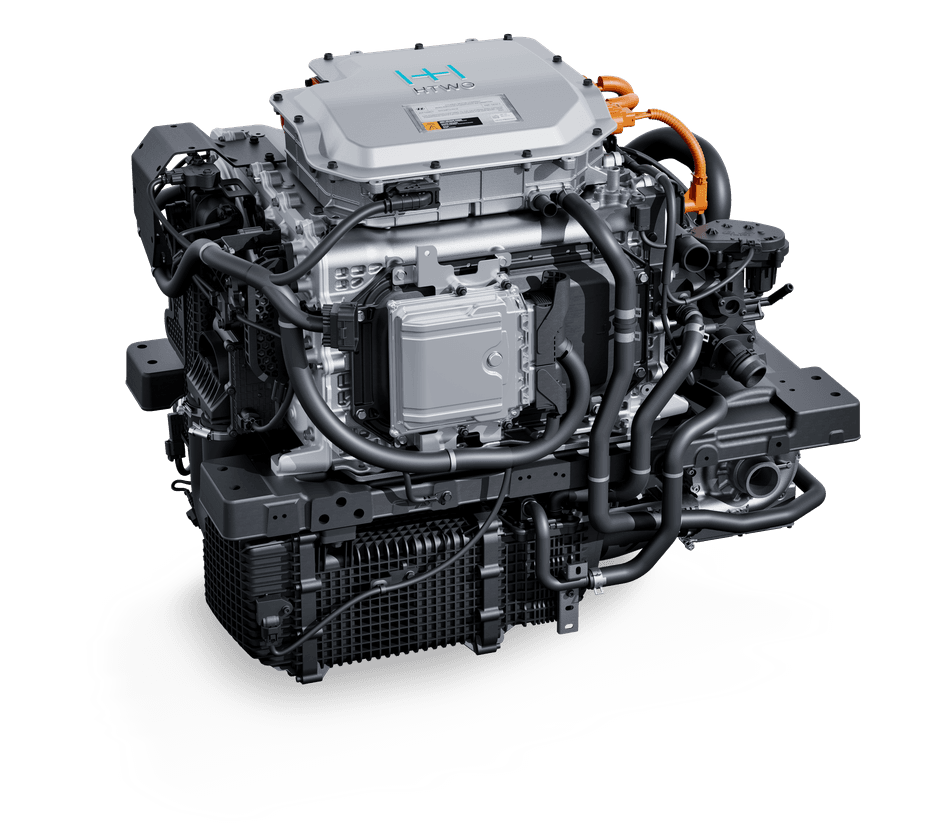
Engine-Type Fuel Cell System
The driving force behind Hyundai’s hydrogen mobility.
Proven through the
real-world
operation of approximately 54,000 fuel cell electric vehicles worldwide (as of August
2026), it
delivers verified safety and durability, along with high efficiency and outstanding
power
performance.
- Max. power
-
94 kW
net
- Efficiency
-
61.7 %
Max.
- Cumulative units deployed
-
Nearly 54,000 vehicles
Based on Hyundai Motor Company FCEVs

Engine-Type Fuel Cell System
| Performance | Max. power | 94 kW net |
|---|---|---|
| Min. power | 30 kW net | |
| Voltage |
PMC out : 250 ~ 450 V / FDC out (Supplied) : 450 ~ 828 V |
|
| Current | 360 A | |
| Efficiency | Max. 61.7% | |
| Specification | Size | 651 x 888 x 718 mm (L x W x H) |
| Weight | 181 kg | |
| Volume | 415 L | |
| IP rating | IP67 / IP69K | |
| Operating environment | Ambient temperature | -30 ~ 50 ℃ |
| Hydrogen quality | ISO 14687-2 / SAE J2719 | |
| Hydrogen pressure | 18 bara ± 1.5 bar | |
| Supply voltage | PMC : 12 V DC / FDC : 12 ~ 24 V DC | |
| Communication | HS CAN (2.0B 500kbit/s, extended ID) | |
| Applications | Applications | Light commercial vehicles, passenger cars, medium/heavy-duty trucks, special vehicles, city/coach buses, power generators |
※ The specified net power is the performance reference value measured in the initial state (BOL) of the fuel cell stack and system.
Where Can It Be Applied?
Passenger and Commercial Vehicles
-

NEXO

Hyundai’s first dedicated fuel cell electric vehicle with up to 720 km of range and a refueling time of approximately five minutes.
-
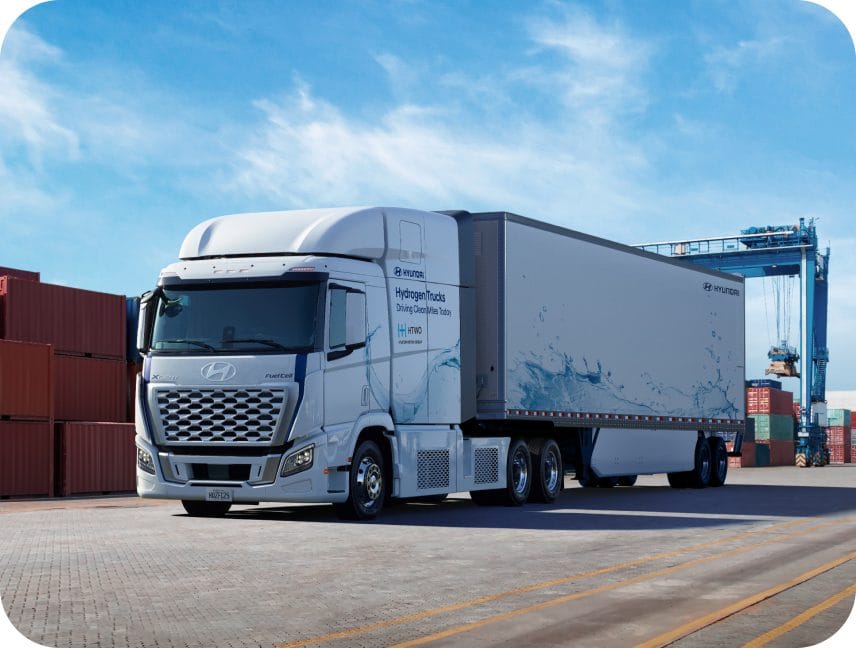
XCIENT Fuel Cell
The world’s first mass-produced Class 8 heavy-duty fuel cell electric truck, designed for long-distance operation and heavy cargo transport.
-
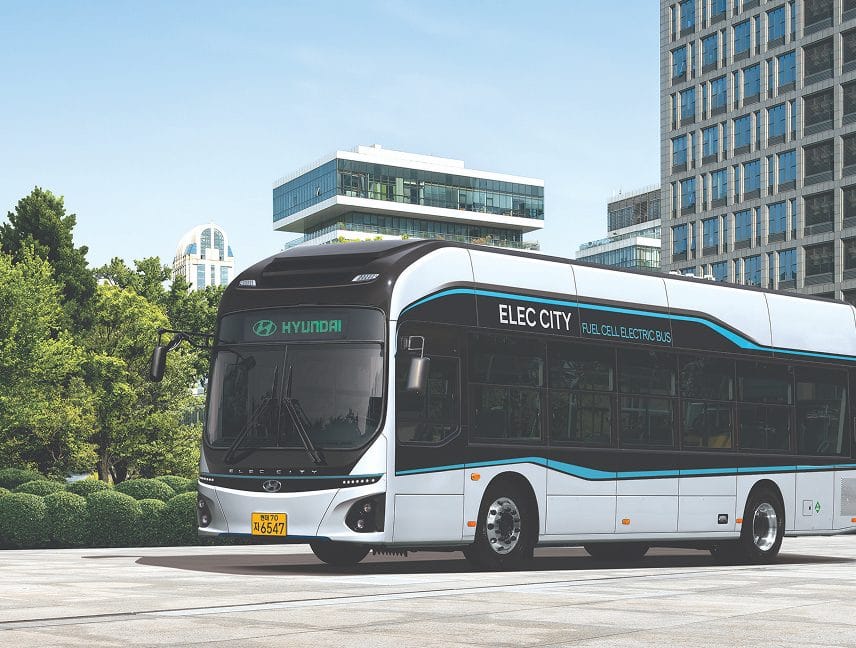
ELEC CITY Fuel Cell
A low-floor fuel cell electric bus optimized for high-frequency urban routes with frequent traffic congestion.
-

UNIVERSE Fuel Cell
A premium heavy-duty fuel cell electric coach offering long-distance efficiency, quiet operation, and zero-emission performance.
Power Generation
-
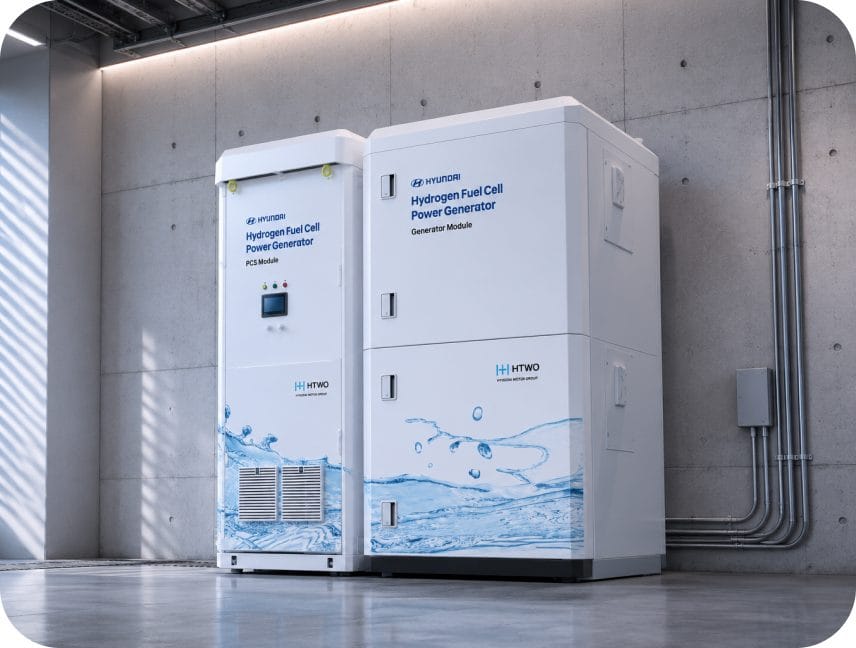
Fuel Cell Power Generator
A fuel cell power-generation solution for grid-connected and distributed power applications.
-
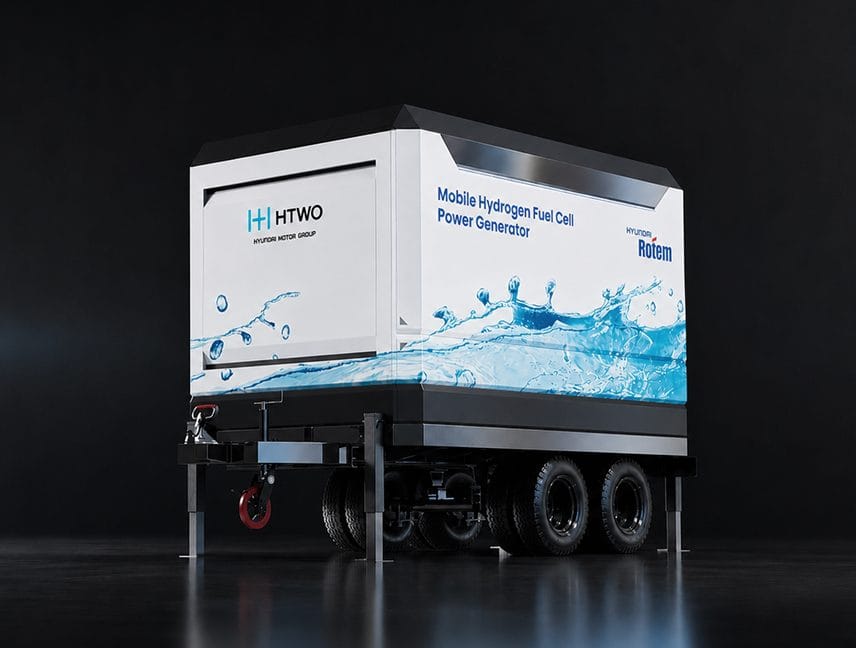
Mobile Power Generator
A mobile power-generation solution for remote areas and outdoor sites where access to the grid is limited.
Port and Logistics Equipment
-
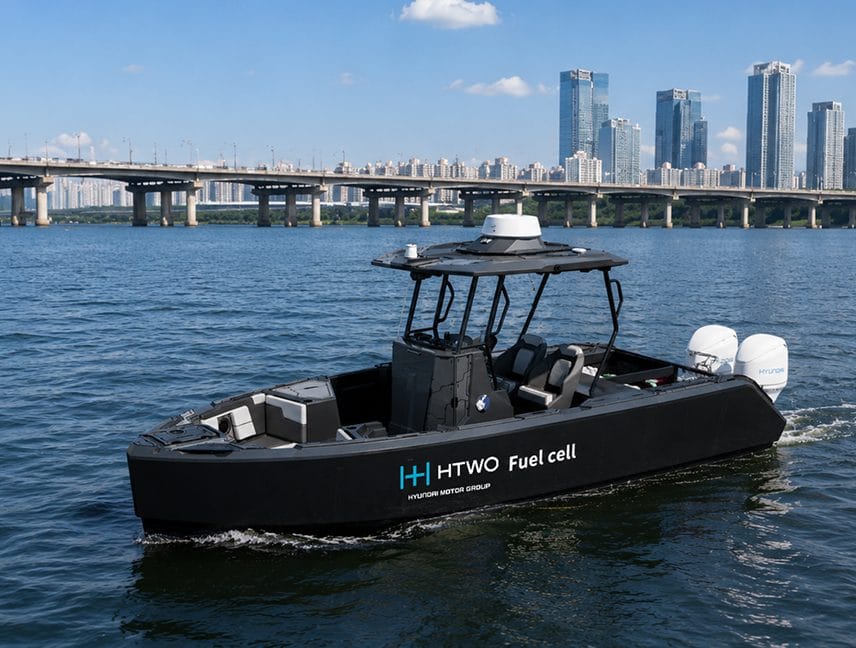
Hydrogen Fuel Cell Electric Ship
An hydrogen-powered propulsion system enabling low-emission operation for port and coastal ships while supporting compliance with maritime emissions regulations.
-
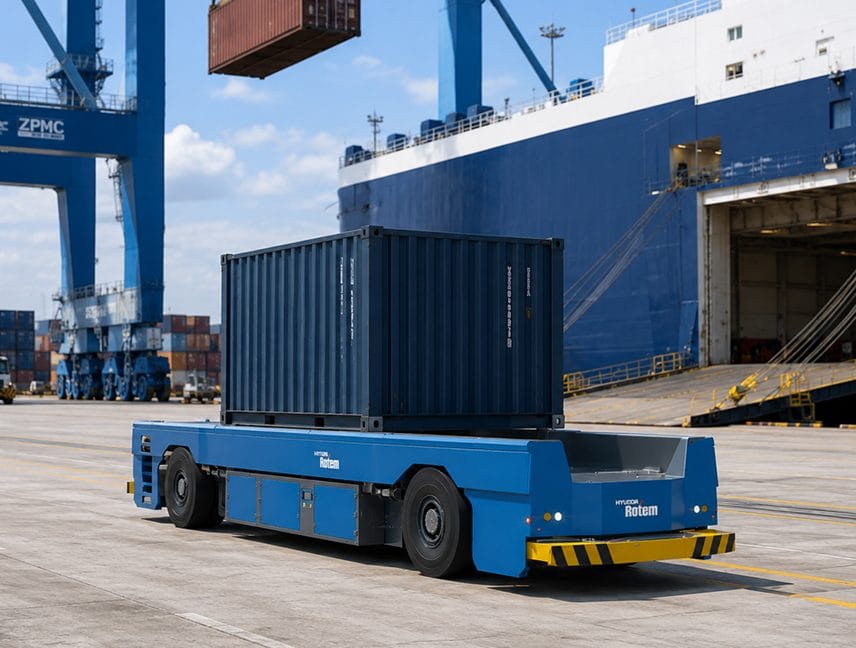
Hydrogen Fuel Cell Electric Port AGV
An automated guided vehicle (AGV) for smart logistics that supports rapid hydrogen refueling and extended operating hours.
-
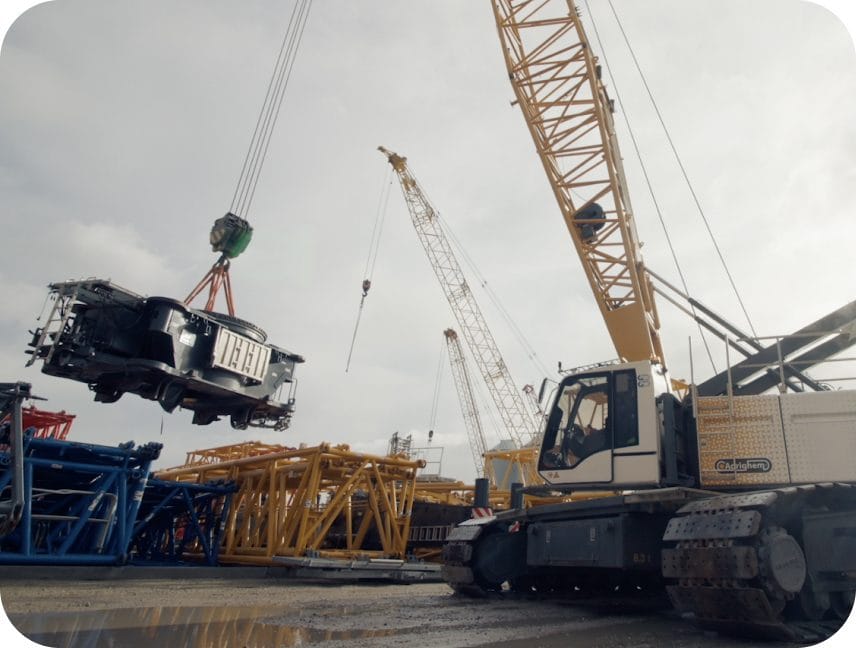
Hydrogen Fuel Cell Electric Crane
Port equipment for heavy loading and unloading operations, designed to reduce carbon emissions and noise.
Special Purpose Vehicles
-

All-Terrain Vehicle (ATV) Powered by Hydrogen
Supports rapid and secure military mobility through a compact, lightweight platform optimized for air transport.
-
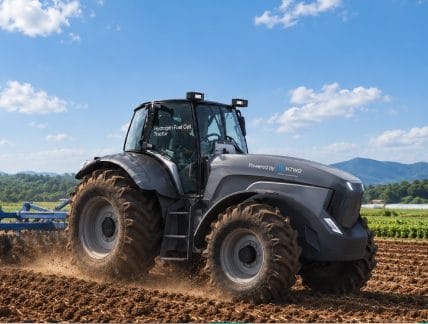
Hydrogen Fuel Cell Electric Agricultural Tractor
Designed for stable high-load agricultural work, helping reduce carbon emissions and improve operational efficiency.
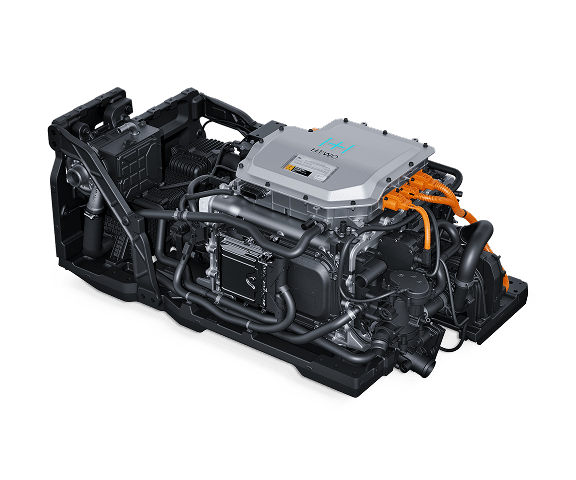
Flat-Type Fuel Cell System
A system designed for applications with significant space constraints, such as trams,
trains, and
buses.
It overcomes space constraints by reducing the system height by 30.8%
compared to the
engine type, and improves power density by incorporating an integrated module for the
cooling
system and controller.
- Max. power
-
94 kW
net
- Efficiency
-
61.7 %
Max.
- System height
-
-30.8 %
Reduced compared to engine-type
Flat-Type Fuel Cell System
| Performance | Max. output | 94 kW net |
|---|---|---|
| Min. power | 30 kW net | |
| Voltage |
PMC out : 250 ~ 450 V / FDC out (Supplied) : 450 ~ 828 V |
|
| Current | 360 A | |
| Efficiency | Max. 61.7% | |
| Specifications | Size | 680 x 1,188 x 502 mm (L x W x H) |
| Weight | 195 kg | |
| Volume | 406 L | |
| IP rating | IP69K | |
| Operating environment | Ambient temperature | -30 ~ 50 ℃ |
| Hydrogen quality | ISO 14687-2 / SAE J2719 | |
| Hydrogen pressure | 18 bara ± 1.5 bar | |
| Supply voltage | PMC : 12 V DC / FDC : 12 ~ 24 V DC | |
| Communication | HS CAN (2.0B 500kbit/s, extended ID) | |
| Applications | Applications | Rail mobility (trams, trains, etc.), city/intercity buses |
※ The specified net power is the performance reference value measured in the initial state (BOL) of the fuel cell stack and system.
Where Can It Be Applied?
Rail Mobility
-
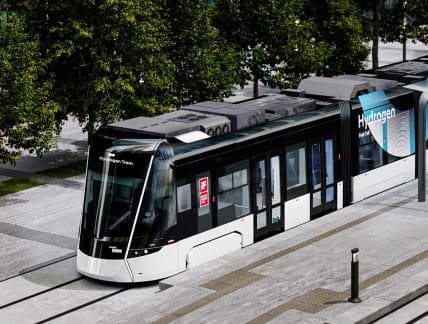
Hydrogen Fuel Cell Tram
Low-emission urban public transportation that does not require high-voltage infrastructure
-
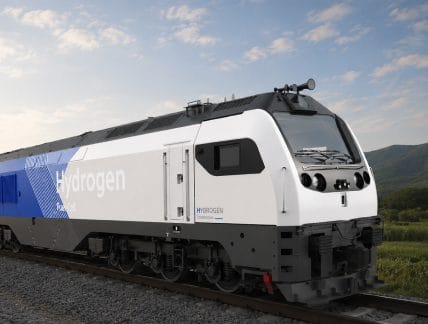
Hydrogen Fuel Cell Locomotive
Hydrogen-powered rail mobility capable of long-distance freight and passenger transport without electrification
Fuel Cell Power Pack
An integrated power package that combines a fuel cell system, battery, and hydrogen
storage
tank.
Designed for industrial vehicles such as forklifts, it enables rapid
refueling and
long-duration operation.
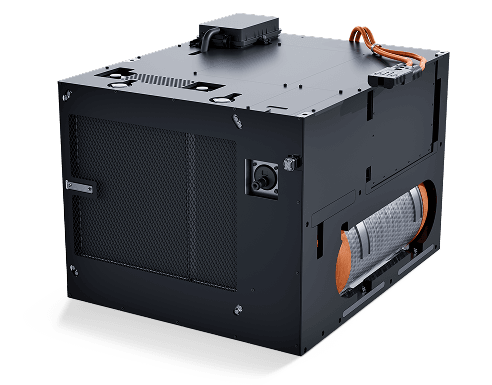
- Max. power / Rated power
-
30 kW / 20 kW
net
- Efficiency
-
54.4 kW
@Rated power
- Integrated package configuration
-
All-in-One
Fuel Cell System + Hydrogen Storage
Fuel Cell Power Pack
| Performance | Max. power | 30 kW net(Peak 60 kW net for 5 sec, varies depending on operating conditions) |
|---|---|---|
| Rated power | 20 kW net | |
| Voltage | 72 ~ 94V DC | |
| Current | 250 A | |
| Efficiency | 54.4% @Rated power | |
| Specifications | Size | 1,030 x 855 x 780 mm (L x W x H) |
| Weight | 964 kg | |
| Battery capacity | 4.0 kWh | |
| IP rating | IP24 | |
| Installation environment | Ambient temperature | -20 ~ 50 ℃ |
| Hydrogen quality | ISO 14687-2 / SAE J2719 | |
| Hydrogen pressure | 700 bar | |
| Supply voltage | PMC : 12 V DC / FDC : 12 ~ 24 V DC | |
| Communication | HS CAN (2.0A 250kbit/s) | |
| Hydrogen tank capacity | 52 L (2.11 kg) | |
| Operating hours | 4 ~ 5 hr*Actual operating time may vary depending on driving conditions. | |
| Certification | Certification | KGS AH372 |
| Applications | Applications | Logistics vehicles (forklifts, etc.), industrial equipment (aerial work vehicles, construction equipment, agricultural machinery, etc.), port equipment |
※ The specified net power is the performance reference value measured in the initial state (BOL) of the fuel cell stack and system.
Where Can It Be Applied?
Heavy Equipment and Industrial Vehicles
-
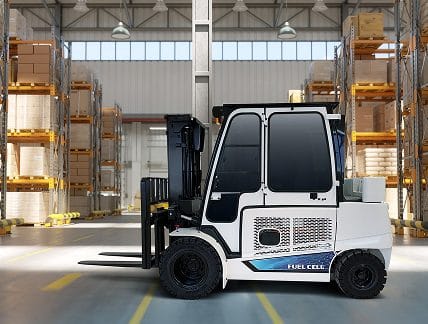
Hydrogen Fuel Cell Electric Forklift
Zero-emission operation in indoor and outdoor environments, including warehouses and construction sites, with rapid refueling for continuous work.
-
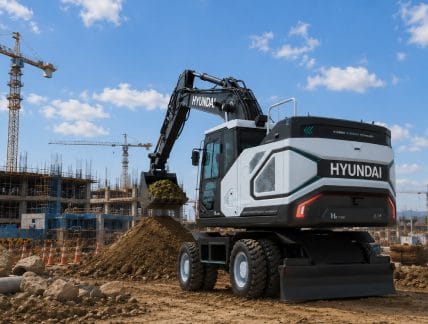
Hydrogen Fuel Cell Electric Excavator
Equipment that reduces carbon emissions at construction sites through eco-friendly and low-noise operation
Port and Logistics Equipment
-
Hydrogen Fuel Cell Electric Port AGV
An automated guided vehicle (AGV) for smart logistics that supports rapid hydrogen refueling and extended operating hours.
Special Purpose Vehicles
-
All-Terrain Vehicle (ATV) Powered by Hydrogen
Supports rapid and secure military mobility through a compact, lightweight platform optimized for air transport.
-
Hydrogen Fuel Cell Electric Agricultural Tractor
Stably performs high-load agricultural tasks, contributing to carbon emission reduction and improved work efficiency.
Passenger and Commercial Vehicles
Passenger and commercial vehicles requiring long driving ranges, heavy-duty transport, and rapid charging demand hydrogen fuel cells capable of high output and stable continuous operation. To meet these demands, HTWO is continuously improving quality, durability, and safety performance based on real-world driving data.
Considering a New Application?-
NEXO
Hyundai’s first dedicated fuel cell electric vehicle with up to 720 km of range and a refueling time of approximately five minutes.
Applied Solutions Engine-Type Fuel Cell System -
XCIENT Fuel Cell
The world’s first mass-produced Class 8 heavy-duty fuel cell electric truck, designed for long-distance operation and heavy cargo transport.
Applied Solutions Engine-Type Fuel Cell System -
ELEC CITY Fuel Cell
Low-floor hydrogen electric bus optimized for operation on city routes with high daily traffic volume and frequent traffic congestion
Applied Solutions Engine-Type Fuel Cell System -
UNIVERSE Fuel Cell
A premium heavy-duty fuel cell electric coach offering long-distance efficiency, quiet operation, and zero-emission performance.
Applied Solutions Engine-Type Fuel Cell System

Which Fuel Cell Solution Powers It?
Contact Us
Engine-Type Fuel Cell System
The driving force behind Hyundai’s hydrogen
mobility.
Proven through the
real-world operation of approximately 54,000 fuel cell electric
vehicles worldwide (as
of August 2026), it delivers verified safety and durability, along
with high efficiency
and outstanding power performance.
- Max. power
-
94 kW
net
- Efficiency
-
61.7 %
Max.
- Cumulative units deployed
-
Nearly 54,000 vehicles
Based on Hyundai Motor Company FCEVs
Engine-Type Fuel Cell System
| Performance | Max. power | 94 kW net |
|---|---|---|
| Min. power | 30 kW net | |
| Voltage |
PMC out : 250 ~ 450 V / FDC out (Supplied) : 450 ~ 828 V |
|
| Current | 360 A | |
| Efficiency | Max. 61.7% | |
| Specification | Size | 651 x 888 x 718 mm (L x W x H) |
| Weight | 181 kg | |
| Volume | 415 L | |
| IP rating | IP67 / IP69K | |
| Operating environment | Ambient temperature | -30 ~ 50 ℃ |
| Hydrogen quality | ISO 14687-2 / SAE J2719 | |
| Hydrogen pressure | 18 bara ± 1.5 bar | |
| Supply voltage | PMC : 12 V DC / FDC : 12 ~ 24 V DC | |
| Communication | HS CAN (2.0B 500kbit/s, extended ID) | |
| Applications | Applications | Light commercial vehicles, passenger cars, medium/heavy-duty trucks, special vehicles, city/coach buses, power generators |
※ The specified net power is the performance reference value measured in the initial state (BOL) of the fuel cell stack and system.
Rail Mobility
Rail mobility require integrated designs optimized for operating environments and
vehicle
structures, making flat-type hydrogen fuel cell systems an ideal
solution.
Installed on the
roof of the vehicle, they ensure stable and reliable power delivery. Leveraging this
technology,
Hyundai Rotem continues to expand its hydrogen-powered rail mobility lineup.
-
Hydrogen Fuel Cell Tram
Eco-friendly urban public transportation that does not require high-voltage infrastructure
Applied Solutions Flat-Type Fuel Cell System -
Hydrogen Fuel Cell Locomotive
Eco-friendly rail mobility capable of long-distance freight and passenger transport without electrification
Applied Solutions Flat-Type Fuel Cell System
Which Fuel Cell Solution Powers It?
Contact Us
Flat-Type Fuel Cell System
A system designed for applications with significant space
constraints, such as trams,
trains, and buses.
It overcomes space constraints by reducing
the system height by
30.8% compared to the engine type, and improves power density by
incorporating an
integrated module for the cooling system and controller.
- Max. power
-
94 kW
net
- Efficiency
-
61.7 %
Max.
- System height
-
-30.8 %
Reduced compared to engine-type
Flat-Type Fuel Cell System
| Performance | Max. output | 94 kW net |
|---|---|---|
| Min. power | 30 kW net | |
| Voltage |
PMC out : 250 ~ 450 V / FDC out (Supplied) : 450 ~ 828 V |
|
| Current | 360 A | |
| Efficiency | Max. 61.7% | |
| Specifications | Size | 680 x 1,188 x 502 mm (L x W x H) |
| Weight | 195 kg | |
| Volume | 406 L | |
| IP rating | IP69K | |
| Operating environment | Ambient temperature | -30 ~ 50 ℃ |
| Hydrogen quality | ISO 14687-2 / SAE J2719 | |
| Hydrogen pressure | 18 bara ± 1.5 bar | |
| Supply voltage | PMC : 12 V DC / FDC : 12 ~ 24 V DC | |
| Communication | HS CAN (2.0B 500kbit/s, extended ID) | |
| Applications | Applications | Rail mobility (trams, trains, etc.), city/intercity buses |
※ The specified net power is the performance reference value measured in the initial state (BOL) of the fuel cell stack and system.
Power Generation
In the power generation sector, where continuous power supply and rapid response are required, engine-type hydrogen fuel cells capable of independent power production are utilized. In particular, hydrogen fuel cell generators are systems that can flexibly adjust the scale of power by integrating modules in series and parallel, supplying enough power for approximately 217 households to use for one month.
Considering a New Application?-
Fuel Cell Power Generator
Fuel cell power generation solution capable of grid connection and distributed generation
Applied Solutions Engine-Type Fuel Cell System -
Mobile Power Generator
Power generation solutions for areas with difficult electricity supply and outdoor sites
Applied Solutions Engine-Type Fuel Cell System
Which Fuel Cell Solution Powers It?
Contact Us
Engine-Type Fuel Cell System
The driving force behind Hyundai’s hydrogen
mobility.
Proven through the
real-world operation of approximately 54,000 fuel cell electric
vehicles worldwide (as
of August 2026), it delivers verified safety and durability, along
with high efficiency
and outstanding power performance.
- Max. power
-
94 kW
net
- Efficiency
-
61.7 %
Max.
- Cumulative units deployed
-
Nearly 54,000 vehicles
Based on Hyundai Motor Company FCEVs
Engine-Type Fuel Cell System
| Performance | Max. power | 94 kW net |
|---|---|---|
| Min. power | 30 kW net | |
| Voltage |
PMC out : 250 ~ 450 V / FDC out (Supplied) : 450 ~ 828 V |
|
| Current | 360 A | |
| Efficiency | Max. 61.7% | |
| Specification | Size | 651 x 888 x 718 mm (L x W x H) |
| Weight | 181 kg | |
| Volume | 415 L | |
| IP rating | IP67 / IP69K | |
| Operating environment | Ambient temperature | -30 ~ 50 ℃ |
| Hydrogen quality | ISO 14687-2 / SAE J2719 | |
| Hydrogen pressure | 18 bara ± 1.5 bar | |
| Supply voltage | PMC : 12 V DC / FDC : 12 ~ 24 V DC | |
| Communication | HS CAN (2.0B 500kbit/s, extended ID) | |
| Applications | Applications | Light commercial vehicles, passenger cars, medium/heavy-duty trucks, special vehicles, city/coach buses, power generators |
※ The specified net power is the performance reference value measured in the initial state (BOL) of the fuel cell stack and system.
Heavy Equipment and Industrial Vehicles
In construction sites requiring high power output and durability, hydrogen fuel cells are flexibly applied depending on the equipment characteristics and usage environment. In particular, the power pack can be mounted even on equipment with space constraints and can be effectively applied to equipment requiring a counterweight by utilizing its own weight.
Considering a New Application?-
Hydrogen Fuel Cell Electric Forklift
Operates without emissions in indoor and outdoor environments, such as logistics warehouses and construction sites. Enables continuous operation with rapid recharging.
Applied Solutions Fuel Cell Power Pack -
Hydrogen Fuel Cell Electric Excavator
Heavy equipment that reduces carbon emissions at construction sites through eco-friendly and low-noise operation
Applied Solutions Fuel Cell Power Pack
Which Fuel Cell Solution Powers It?
Contact Us
Fuel Cell Power Pack
An integrated power package that combines a fuel cell system,
battery, and hydrogen
storage tank.
Designed for industrial vehicles such as
forklifts, it enables rapid
refueling and long-duration operation.
- Max. power / Rated power
-
30 kW / 20 kW
net
- Efficiency
-
54.4 kW
@Rated power
- Integrated package configuration
-
All-in-One
Fuel Cell System + Hydrogen Storage
Fuel Cell Power Pack
| Performance | Max. power | 30 kW net(Peak 60 kW net for 5 sec, varies depending on operating conditions) |
|---|---|---|
| Rated power | 20 kW net | |
| Voltage | 72 ~ 94V DC | |
| Current | 250 A | |
| Efficiency | 54.4% @Rated power | |
| Specifications | Size | 1,030 x 855 x 780 mm (L x W x H) |
| Weight | 964 kg | |
| Battery capacity | 4.0 kWh | |
| IP rating | IP24 | |
| Installation environment | Ambient temperature | -20 ~ 50 ℃ |
| Hydrogen quality | ISO 14687-2 / SAE J2719 | |
| Hydrogen pressure | 700 bar | |
| Supply voltage | PMC : 12 V DC / FDC : 12 ~ 24 V DC | |
| Communication | HS CAN (2.0A 250kbit/s) | |
| Hydrogen tank capacity | 52 L (2.11 kg) | |
| Operating hours | 4 ~ 5 hr*Actual operating time may vary depending on driving conditions. | |
| Certification | Certification | KGS AH372 |
| Applications | Applications | Logistics vehicles (forklifts, etc.), industrial equipment (aerial work vehicles, construction equipment, agricultural machinery, etc.), port equipment |
※ The specified net power is the performance reference value measured in the initial state (BOL) of the fuel cell stack and system.
Port and Logistics Equipment
In port and logistics environments characterized by long operating hours and repetitive tasks, engine-type and power pack-based hydrogen fuel cells are utilized to accommodate various types of equipment. In particular, hydrogen fuel cells contribute to decarbonization in the port sector, where reducing carbon emissions is difficult, and are an effective solution for improving the working environment due to their low noise and zero-emission characteristics.
Considering a New Application?-
Hydrogen Fuel Cell Electric Ship
Zero-carbon operation of port and coastal ships with an eco-friendly propulsion system to respond to marine carbon regulations
Applied Solutions Engine-Type Fuel Cell System -
Hydrogen Fuel Cell Electric Port AGV
As an Automated Guided Vehicle (AGV) for smart logistics, it enables rapid hydrogen refueling and long-duration operation.
Applied Solutions Fuel Cell Power Pack -
Hydrogen Fuel Cell Electric Crane
Port equipment that performs heavy loading and unloading operations while reducing carbon emissions and noise pollution
Applied Solutions Engine-Type Fuel Cell System
Which Fuel Cell Solution Powers It?
Contact Us
Engine-Type Fuel Cell System
The driving force behind Hyundai’s hydrogen
mobility.
Proven through the
real-world operation of approximately 54,000 fuel cell electric
vehicles worldwide (as
of August 2026), it delivers verified safety and durability, along
with high efficiency
and outstanding power performance.
- Max. power
-
94 kW
net
- Efficiency
-
61.7 %
Max.
- Cumulative units deployed
-
Nearly 54,000 vehicles
Based on Hyundai Motor Company FCEVs
Engine-Type Fuel Cell System
| Performance | Max. power | 94 kW net |
|---|---|---|
| Min. power | 30 kW net | |
| Voltage |
PMC out : 250 ~ 450 V / FDC out (Supplied) : 450 ~ 828 V |
|
| Current | 360 A | |
| Efficiency | Max. 61.7% | |
| Specification | Size | 651 x 888 x 718 mm (L x W x H) |
| Weight | 181 kg | |
| Volume | 415 L | |
| IP rating | IP67 / IP69K | |
| Operating environment | Ambient temperature | -30 ~ 50 ℃ |
| Hydrogen quality | ISO 14687-2 / SAE J2719 | |
| Hydrogen pressure | 18 bara ± 1.5 bar | |
| Supply voltage | PMC : 12 V DC / FDC : 12 ~ 24 V DC | |
| Communication | HS CAN (2.0B 500kbit/s, extended ID) | |
| Applications | Applications | Light commercial vehicles, passenger cars, medium/heavy-duty trucks, special vehicles, city/coach buses, power generators |
※ The specified net power is the performance reference value measured in the initial state (BOL) of the fuel cell stack and system.
Fuel Cell Power Pack
An integrated power package that combines a fuel cell system,
battery, and hydrogen
storage tank.
Designed for industrial vehicles such as
forklifts, it enables rapid
refueling and long-duration operation.
- Max. power / Rated power
-
30 kW / 20 kW
net
- Efficiency
-
54.4 kW
@Rated power
- Integrated package configuration
-
All-in-One
Fuel Cell System + Hydrogen Storage
Fuel Cell Power Pack
| Performance | Max. power | 30 kW net(Peak 60 kW net for 5 sec, varies depending on operating conditions) |
|---|---|---|
| Rated power | 20 kW net | |
| Voltage | 72 ~ 94V DC | |
| Current | 250 A | |
| Efficiency | 54.4% @Rated power | |
| Specifications | Size | 1,030 x 855 x 780 mm (L x W x H) |
| Weight | 964 kg | |
| Battery capacity | 4.0 kWh | |
| IP rating | IP24 | |
| Installation environment | Ambient temperature | -20 ~ 50 ℃ |
| Hydrogen quality | ISO 14687-2 / SAE J2719 | |
| Hydrogen pressure | 700 bar | |
| Supply voltage | PMC : 12 V DC / FDC : 12 ~ 24 V DC | |
| Communication | HS CAN (2.0A 250kbit/s) | |
| Hydrogen tank capacity | 52 L (2.11 kg) | |
| Operating hours | 4 ~ 5 hr*Actual operating time may vary depending on driving conditions. | |
| Certification | Certification | KGS AH372 |
| Applications | Applications | Logistics vehicles (forklifts, etc.), industrial equipment (aerial work vehicles, construction equipment, agricultural machinery, etc.), port equipment |
※ The specified net power is the performance reference value measured in the initial state (BOL) of the fuel cell stack and system.
Special Purpose Vehicles
Military vehicles and agricultural tractors requiring high-load operations and autonomous field operation demand high maneuverability, stable power output, and long-duration continuous driving performance. Hydrogen fuel cells reduce detectability based on their low-noise and low-heat characteristics, and enable stable operation even in extreme environments.
Considering a New Application?-
All-Terrain Vehicle (ATV) Powered by Hydrogen
Supports rapid and safe military mobility through the application of a lightweight and miniaturized platform optimized for air transport
Applied Solutions Engine-Type Fuel Cell System -
Hydrogen Fuel Cell Electric Agricultural Tractor
Stably performs high-load agricultural tasks, contributing to carbon emission reduction and improved work efficiency.
Applied Solutions Engine-Type Fuel Cell System
Which Fuel Cell Solution Powers It?
Contact Us
Engine-Type Fuel Cell System
The driving force behind Hyundai’s hydrogen
mobility.
Proven through the
real-world operation of approximately 54,000 fuel cell electric
vehicles worldwide (as
of August 2026), it delivers verified safety and durability, along
with high efficiency
and outstanding power performance.
- Max. power
-
94 kW
net
- Efficiency
-
61.7 %
Max.
- Cumulative units deployed
-
Nearly 54,000 vehicles
Based on Hyundai Motor Company FCEVs
Engine-Type Fuel Cell System
| Performance | Max. power | 94 kW net |
|---|---|---|
| Min. power | 30 kW net | |
| Voltage |
PMC out : 250 ~ 450 V / FDC out (Supplied) : 450 ~ 828 V |
|
| Current | 360 A | |
| Efficiency | Max. 61.7% | |
| Specification | Size | 651 x 888 x 718 mm (L x W x H) |
| Weight | 181 kg | |
| Volume | 415 L | |
| IP rating | IP67 / IP69K | |
| Operating environment | Ambient temperature | -30 ~ 50 ℃ |
| Hydrogen quality | ISO 14687-2 / SAE J2719 | |
| Hydrogen pressure | 18 bara ± 1.5 bar | |
| Supply voltage | PMC : 12 V DC / FDC : 12 ~ 24 V DC | |
| Communication | HS CAN (2.0B 500kbit/s, extended ID) | |
| Applications | Applications | Light commercial vehicles, passenger cars, medium/heavy-duty trucks, special vehicles, city/coach buses, power generators |
※ The specified net power is the performance reference value measured in the initial state (BOL) of the fuel cell stack and system.
Eco-friendly
A Hydrogen-Powered Powertrain That Emits Only Water
-

2H2
-

O2
-

2H2O


Electricity generated by the reaction between hydrogen and oxygen powers the vehicle, with water vapor as the only tailpipe emission. Hydrogen fuel cell systems enable zero-emission driving and serve as a core technology for sustainable mobility.
High Efficiency
Outstanding fuel efficiency achieved through key system component optimization
Hydrogen fuel cell systems directly convert hydrogen energy into electricity, achieving significantly higher energy efficiency than conventional internal combustion engines. By optimizing each component of the system, they deliver fuel efficiency of up to 61.7%.

Manufacturing Plants
HTWO Manufacturing Footprint
Hyundai has established large-scale manufacturing sites in Korea and overseas, supporting a stable and flexible supply of fuel cell systems tailored to diverse customer needs.
-
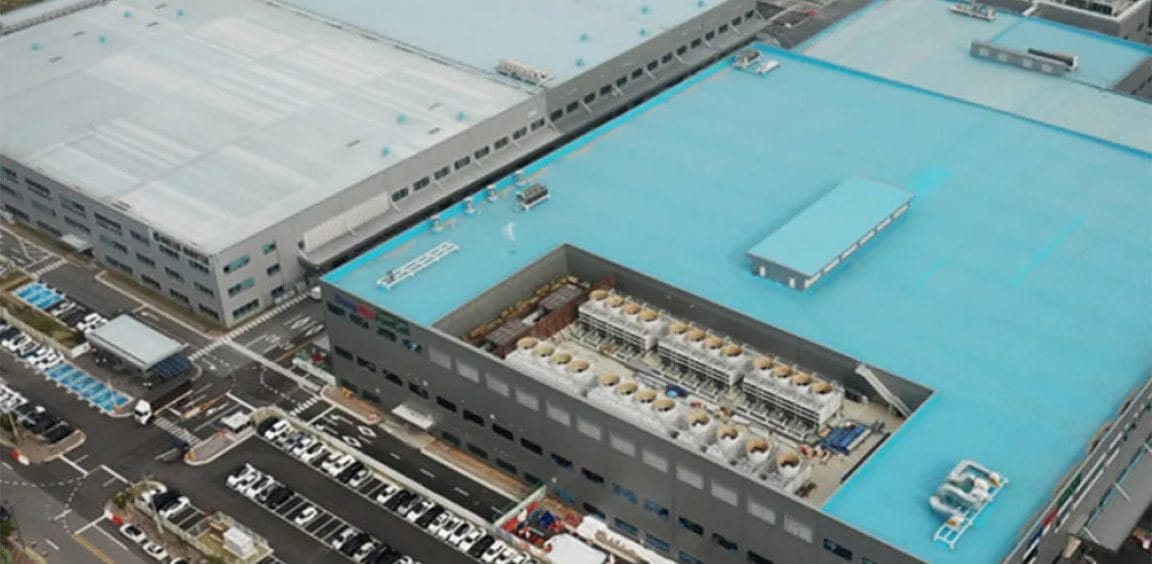
Chungju Fuel Cell System
Production Plant- Annual production capacity
- 20,000+
The world’s first mass-production system for automotive hydrogen fuel cell systems, now providing reliable fuel cell solutions across a wide range of industries.
-
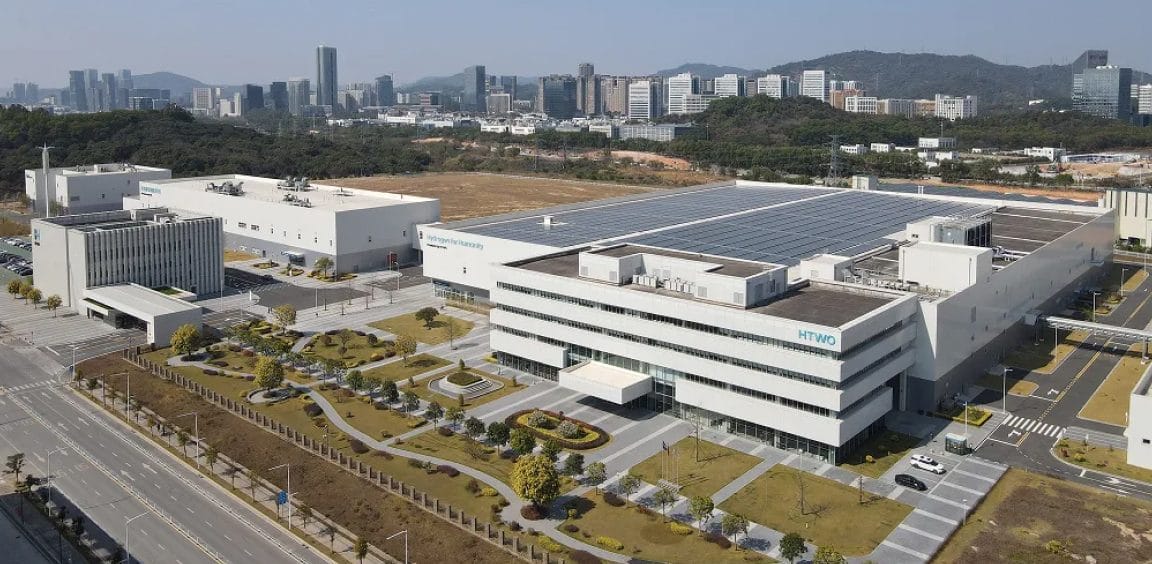
HTWO Guangzhou
- Annual production capacity
- 6,500+
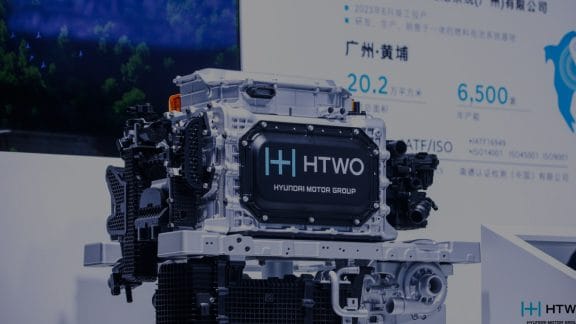
Hyundai Motor Group established HTWO Guangzhou, its first overseas production site for hydrogen fuel cell systems, and began full-scale production.
Building on Hyundai Motor Company’s high-performance fuel cell technology, HTWO Guangzhou is expanding hydrogen applications across China’s commercial-vehicle market.
-
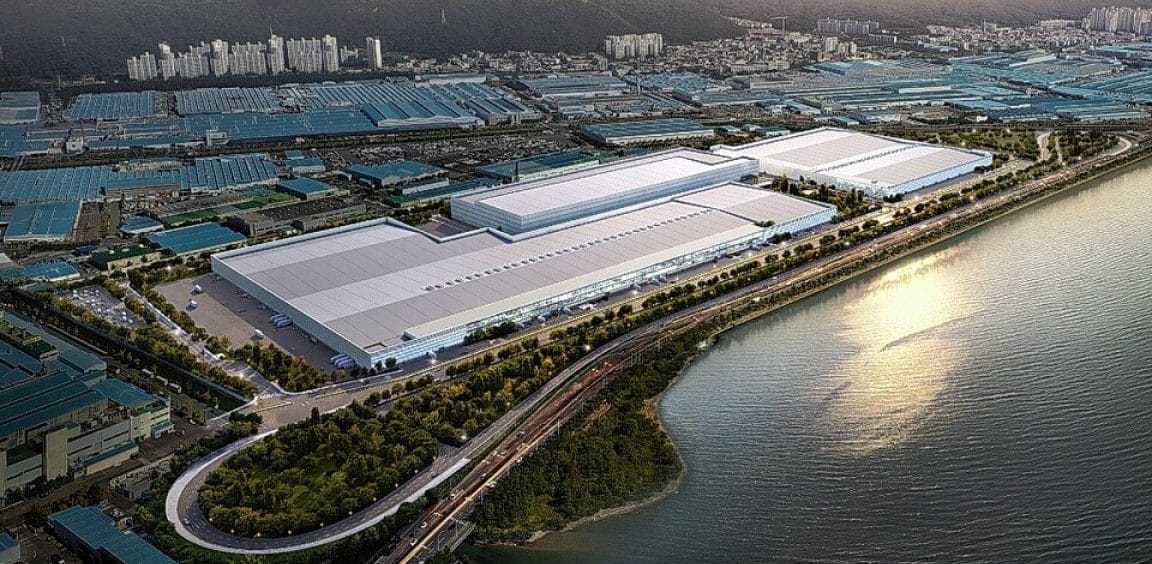
Ulsan New Fuel Cell Plant
(Scheduled for completion in 2027)- Annual production capacity
- 30,000
Next-generation fuel cell systems produced at Hyundai Motor Company’s new Ulsan plant will be optimized separately for passenger and commercial vehicles. Designed for applications including trucks, buses, construction equipment, ships, and agricultural machinery, the systems will deliver performance tailored to different operating environments.
The plant will also produce PEM water electrolyzer stacks that generate high-purity clean hydrogen from water by applying the reverse electrochemical reaction of a fuel cell.
Business
Hydrogen Fuel Cell System and
Power Pack Deployment
-
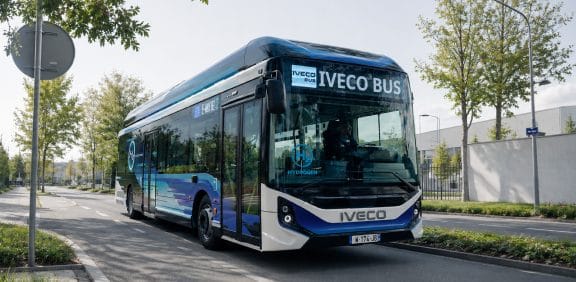
IVECO BUS Fuel Cell Electric City Bus

Joint development of a 12-meter fuel cell electric low-floor city bus with IVECO BUS
Participating affiliates
-
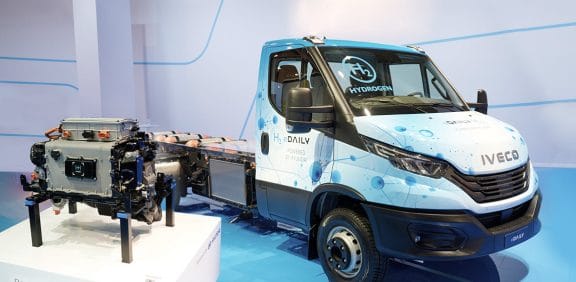
IVECO Group Fuel Cell Electric Large Van
Joint development of a 7-ton fuel cell electric large van with IVECO Group
Participating affiliates
-
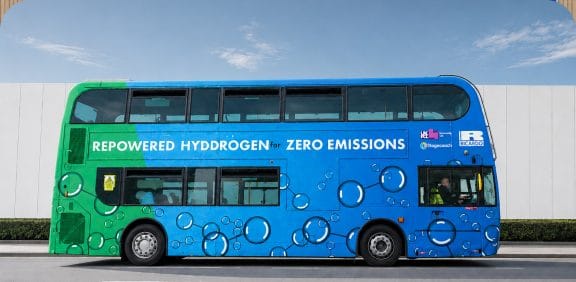
Ricardo Repowered Fuel Cell Electric Bus
Supply of fuel cell systems for Ricardo's repowered diesel double-decker bus in the U.K.
Participating affiliates
-
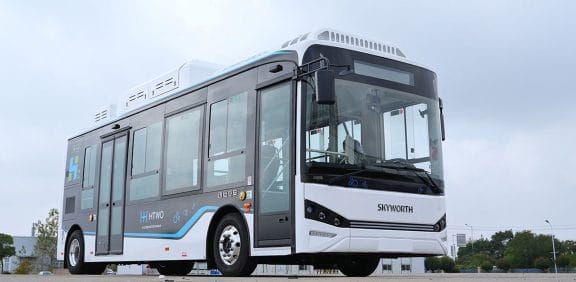
Kaiwo Group Guangzhou Fuel Cell Electric Bus
Joint development of an 8.5-meter fuel cell electric bus with Kaiwo Group
Participating affiliates
-
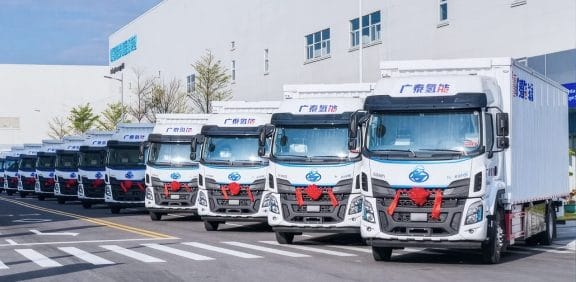
Dongfeng Motor Group Fuel Cell Electric Logistics Truck
Joint development of an 18-ton fuel cell electric logistics truck with Dongfeng Motor Group
Participating affiliates
-
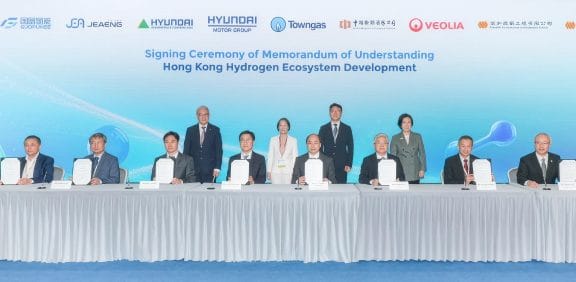
Fuel Cell Buses for Hong Kong's Hydrogen Ecosystem
Supply of fuel cell systems for airport shuttle and tour buses in Hong Kong
Participating affiliates
-
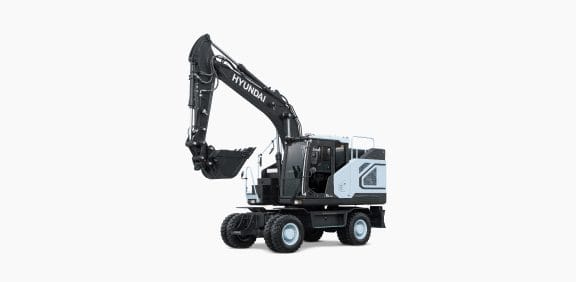
Fuel Cell Systems for Construction and Agricultural Machinery
Development and demonstration of fuel cell systems for construction and agricultural machinery
Participating affiliates
-
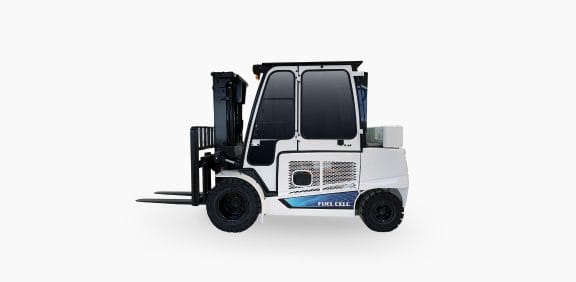
Fuel Cell Systems for Industrial Vehicles
Development and deployment of fuel cell power packs for hydrogen fuel cell electric industrial vehicles
Participating affiliates
-
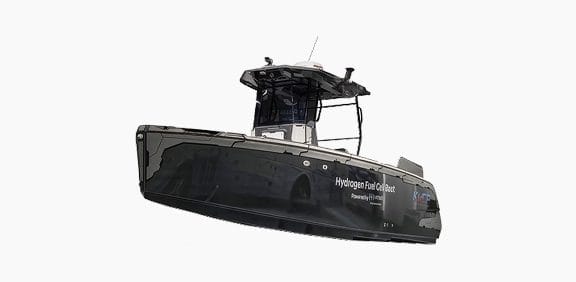
Marine Fuel Cell System Deployment
Supply of fuel cell systems for KMCP's hybrid electric propulsion vessel demonstration
Participating affiliates
-
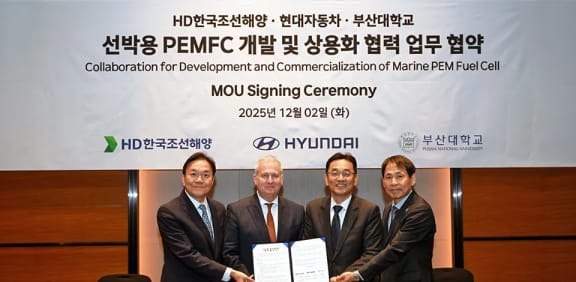
Development and Commercialization of Marine Fuel Cell Systems
Development and commercialization of marine fuel cell systems through collaboration among Hyundai Motor Company, HD Hyundai and Pusan National University Hydrogen Ship Technology Center
Participating affiliates
-
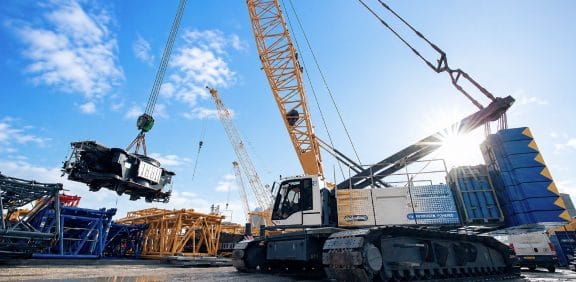
Fuel Cell Systems for Fuel Cell Electric Cranes
Commercial deployment of a fuel cell electric crane developed in collaboration with REEDYK B.V.
Participating affiliates


FAQ
Questions about Hydrogen Fuel Cell Solutions
-
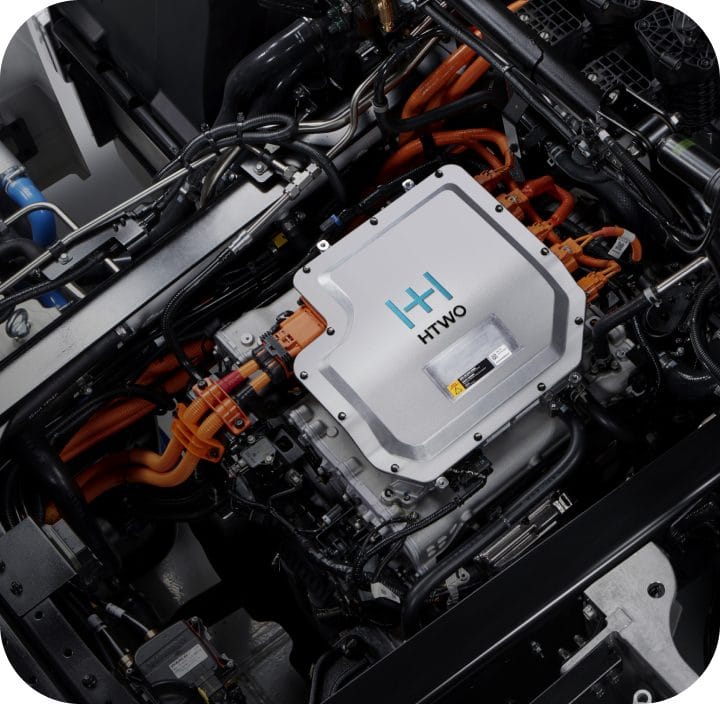
Hydrogen fuel cells generate electricity through an electrochemical reaction between hydrogen and oxygen. Inside the fuel cell stack, hydrogen (H2) reacts with oxygen (O2) from the air to produce electricity and water (H2O).
Because this process operates without combustion, it produces no exhaust emissions; the only by-product is pure water.
-
A battery releases stored electricity, whereas a hydrogen fuel cell generates electricity as it is continuously supplied with hydrogen fuel. With shorter refueling times and longer driving ranges, hydrogen fuel cells are particularly well suited for heavy-duty vehicles and industrial equipment that require extended operating hours.
-
Hydrogen fuel cell systems can be applied across a wide range of applications, from mobility solutions such as passenger vehicles, buses, and heavy-duty trucks to trams, ships, forklifts, excavators, automated guided vehicles (AGVs), military vehicles, and generators.
Depending on the operating conditions and environment, Hyundai offers three configurations: engine-type fuel cell systems, flat-type fuel cell systems, and power packs. Its lineup continues to expand to support an even broader range of applications.
-
The flat-type fuel cell system was developed for application in hydrogen fuel cell trams. Based on an automotive fuel cell system, it was redesigned by rearranging the stack and operating-system components to meet the packaging requirements of tram vehicles.
While the engine-type fuel cell system is designed to fit inside a vehicle’s engine compartment, the flat-type fuel cell system features a reduced height for installation on the roof of a tram.
The redesigned tram-mounted flat-type fuel cell system has been validated for performance and reliability through development and production-stage testing. It is also planned for application in a wider range of uses in the future.
-
Hyundai currently offers a power pack lineup tailored to a range of applications.
The 10 kW power pack is under development for 3-ton-class forklifts. The 100 kW power pack is under development for use in construction, agriculture, ports, and mobile power generation applications, including tractors, excavators, and automated guided vehicles (AGVs).
Going forward, Hyundai plans to develop power packs with a wider range of specifications—including varying power outputs and configurations combining fuel cell systems with hydrogen storage and optional battery systems—to expand hydrogen fuel cell technology across industries.

Contact