
2026.10.16 HTWO
Saemangeum, located in Gunsan City, Jeonbuk State, is a large-scale development area spanning 409 square kilometers, with 291 square kilometers of land and 118 square kilometers of water—about two-thirds the size of Seoul. Its expansive land, abundant sunlight and expanding rail, port and airport connectivity support the development of large-scale solar power and water electrolysis facilities. Together, these conditions provide a foundation for connecting renewable energy production, hydrogen conversion and industrial utilization within a single region.
The Korean government is also developing Saemangeum as a strategic hub for future industries. In May 2025, Hyundai Motor Group signed a memorandum of understanding (MOU) with the Saemangeum Development and Investment Agency to introduce future mobility technologies and establish an AI-based smart city. In February 2026, Hyundai signed an investment MOU with government ministries, Jeonbuk State and other stakeholders to advance robotics and hydrogen industries and create an AI Hydrogen City, marking a major step toward establishing the region as an innovation and growth hub.
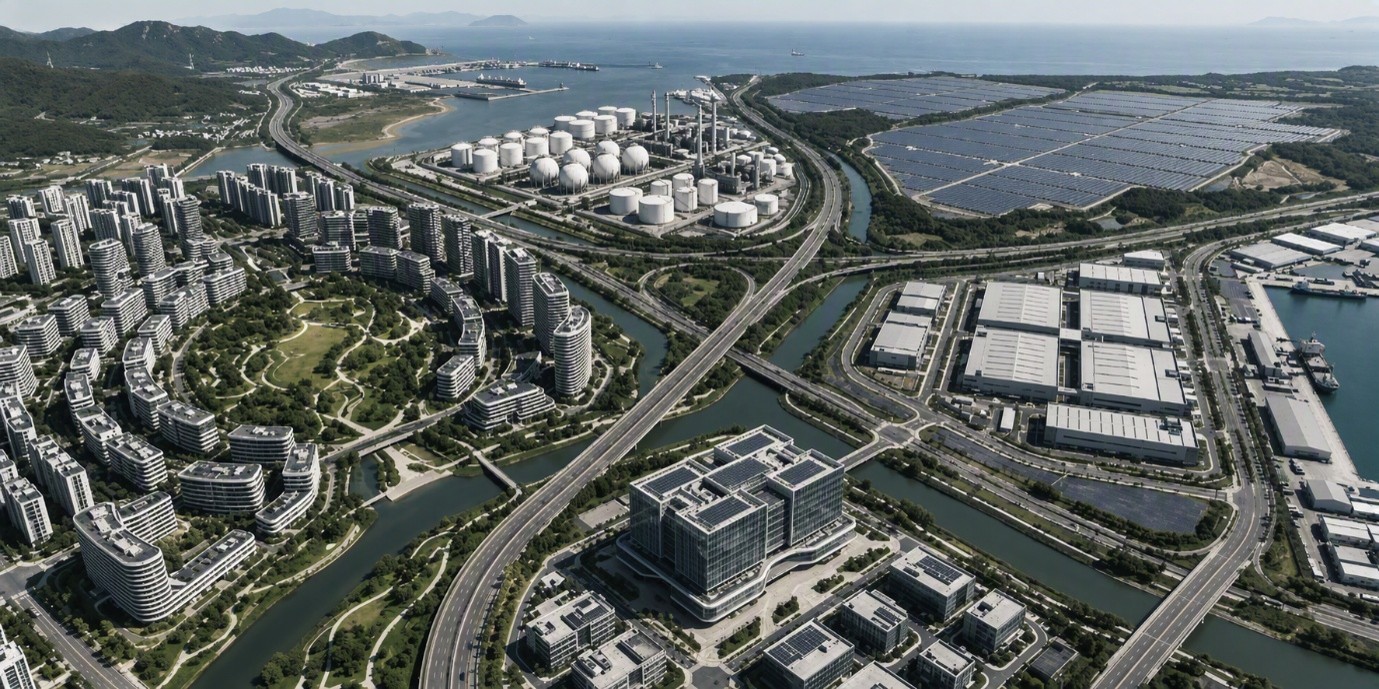
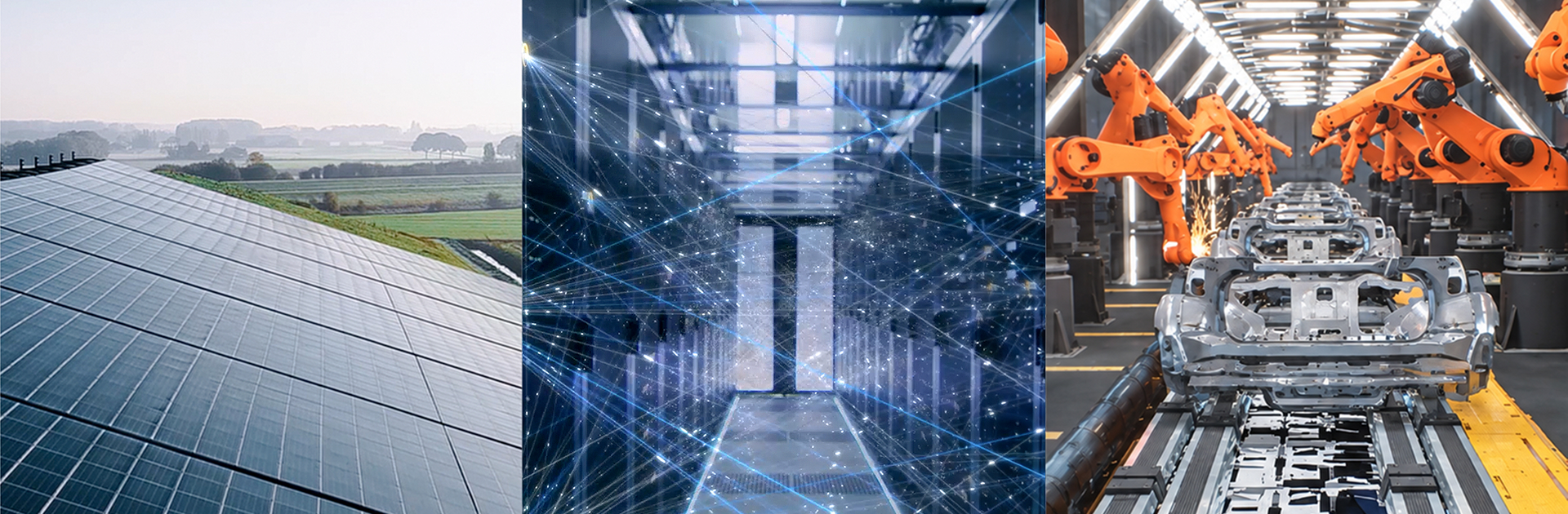
Saemangeum AI Valley will bring together five initiatives: gigawatt-scale solar power generation, a 200-megawatt (MW)-scale water electrolysis plant, an AI Data Center, a Robotics Manufacturing Facility and an AI Hydrogen City. The project is intended to build an integrated value chain linking energy production, storage, conversion and utilization with advanced industrial operations. Solar-generated electricity will be converted into hydrogen for urban, industrial and mobility applications, while supporting the growth of AI and robotics industries.
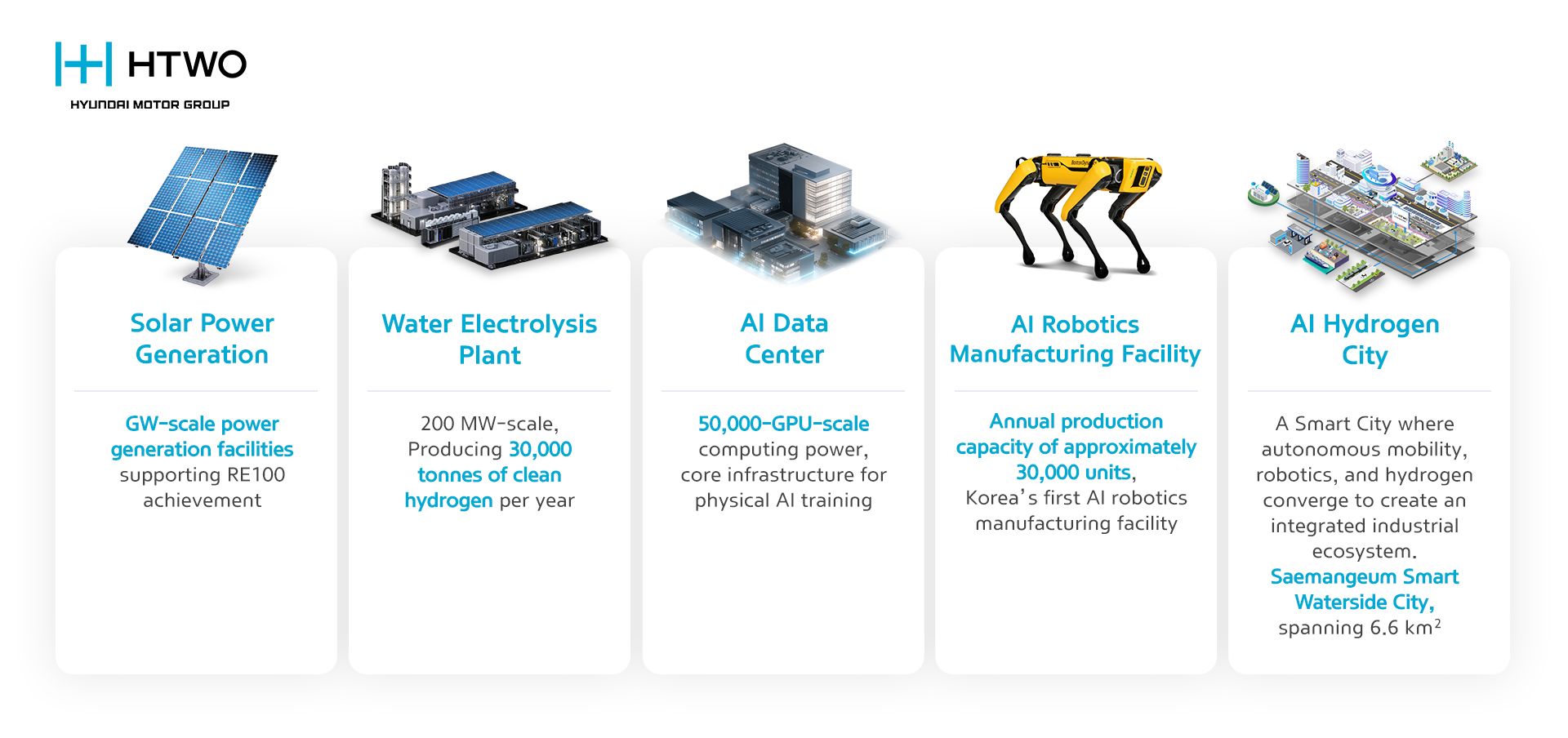
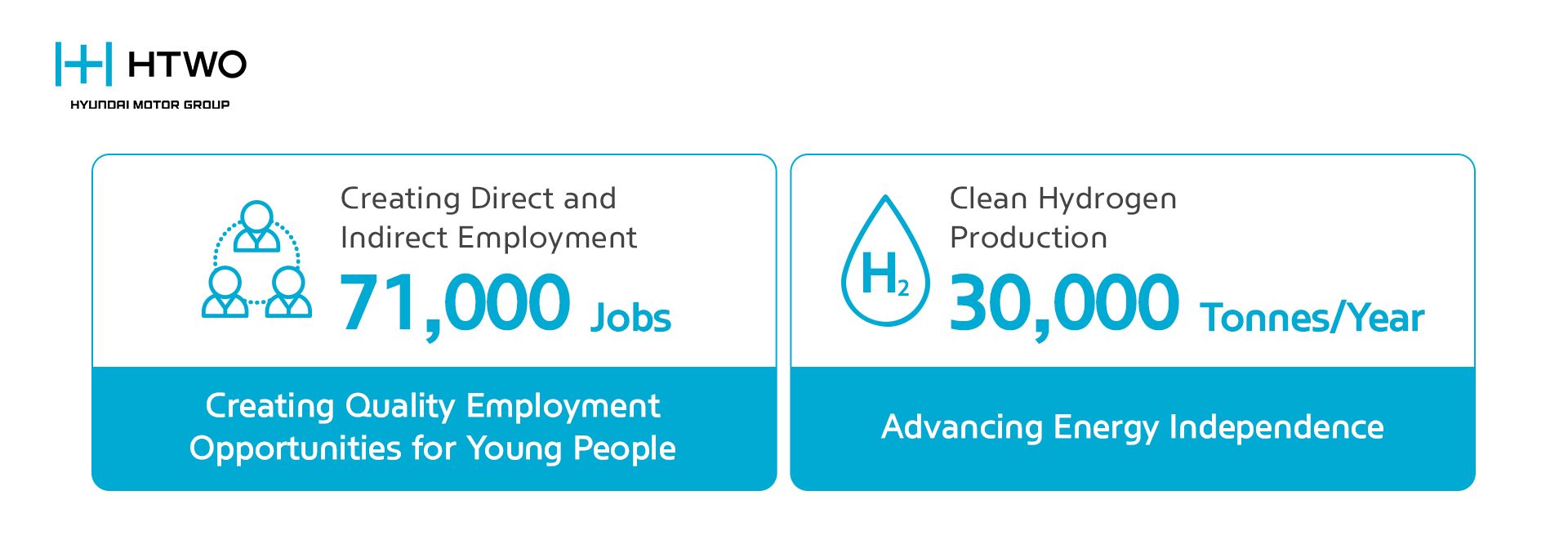
The 200 MW-scale water electrolysis plant is planned to produce approximately 30,000 metric tons of clean hydrogen annually, and Saemangeum AI Valley is expected to create approximately 71,000 direct and indirect jobs. The Ministry of Land, Infrastructure and Transport (MOLIT); the Ministry of Science and ICT (MSIT); the Ministry of Trade, Industry and Resources (MOTIR); and the Ministry of Climate, Energy and Environment (MCEE), alongside Jeonbuk State, will support the AI Hydrogen City, data center, robotics industry, clean hydrogen and power infrastructure. Hyundai Motor Group will contribute its capabilities in water electrolysis, fuel cells, hydrogen mobility, AI and robotics across industrial and urban settings.
The project is expected to advance the energy transition and next-generation manufacturing while creating quality hydrogen-related jobs, strengthening national competitiveness and regional economic growth.
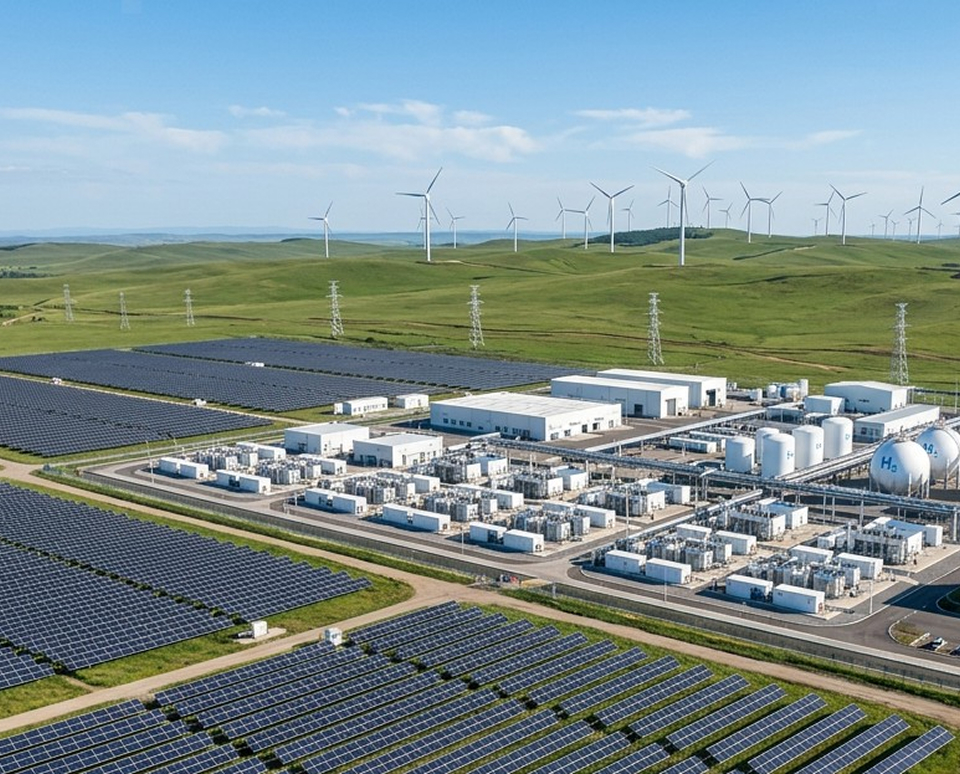
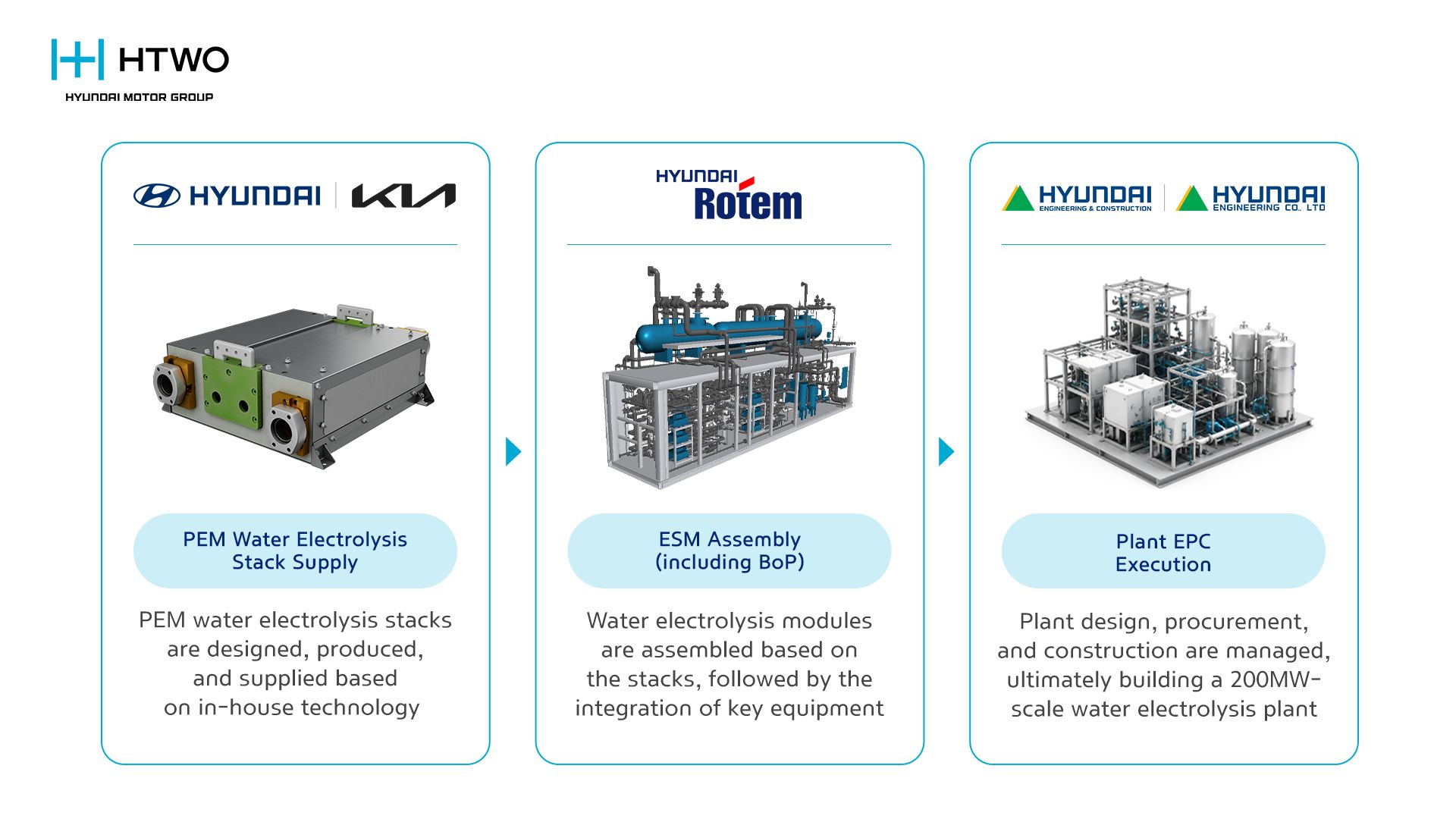
Saemangeum AI Valley is designed to use its renewable energy resources to produce clean hydrogen through the planned 200 MW-scale water electrolysis plant. Powered by solar-generated electricity from Saemangeum, the plant will convert renewable electricity into hydrogen for storage when supply and demand do not align, enabling its use across urban and industrial applications.
Water electrolysis is a Power-to-Hydrogen (P2H) technology that uses electricity to split water into hydrogen and oxygen. Its responsiveness to changes in renewable energy generation makes it well suited to variable sources such as solar power, while its high-power density and modular design enable compact, scalable systems.
Drawing on nearly three decades of fuel cell expertise, Hyundai has advanced its PEM water electrolysis technology by sharing core technologies and components across fuel cell and water electrolysis systems. The Group has achieved over 90 percent localization and is developing a 5 MW-class Electrolyzer Stack Module (ESM) based on a 400-kilowatt (kW)-class electrolyzer stack. Multiple ESMs can be connected in parallel to scale up plant capacity to several hundred megawatts.
Clean hydrogen from the Saemangeum water electrolysis plant will be supplied through pipelines and future distribution infrastructure to the AI Hydrogen City, industrial facilities, mobility applications and power generation facilities.
The AI Hydrogen City will be developed within the Saemangeum Smart Waterfront City, where the government is building infrastructure across approximately 6.6 square kilometers. Green hydrogen will power mobility solutions including the NEXO, fuel cell electric trucks, fuel cell electric buses and demand-responsive transport (DRT) services. Fuel cell-generated electricity will also provide stable power for urban systems and daily infrastructure, as well as emergency and auxiliary power for facilities such as the AI data center and water electrolysis plant.
In this way, Saemangeum AI Valley is envisioned as a future energy ecosystem connecting renewable energy and hydrogen to power cities, industries and mobility. The project will demonstrate an integrated green hydrogen value chain — from production and storage to supply and utilization — within a single urban area.
Solar-generated electricity produced in Saemangeum will also power the AI data center. With a planned capacity of approximately 50,000 graphics processing units (GPUs), the facility will provide large-scale computing infrastructure comparable to Korea’s major industrial AI platforms. It will process and analyze data from industrial operations and robotics, while serving as a foundation for the adjacent robotics manufacturing cluster.
Saemangeum AI Valley will establish a robotics industry hub spanning robot manufacturing, component production and validation. The initiative will draw on Hyundai’s extensive experience in mass production and global supply chain operations gained through vehicle manufacturing, as well as vast volumes of real-world manufacturing data and experience developing and mass-producing wearable and logistics robots. The Group plans to develop robot manufacturing and foundry facilities for its own robots and products developed by small and medium-sized enterprises, while helping automotive component suppliers expand into the robotics industry.
The Robot Application Center ― a facility for validating the application technology and reliability of Physical AI ― is also planned to assess the safety and reliability of autonomous vehicles and robots, providing key infrastructure for the growth of Korea’s robotics industry.
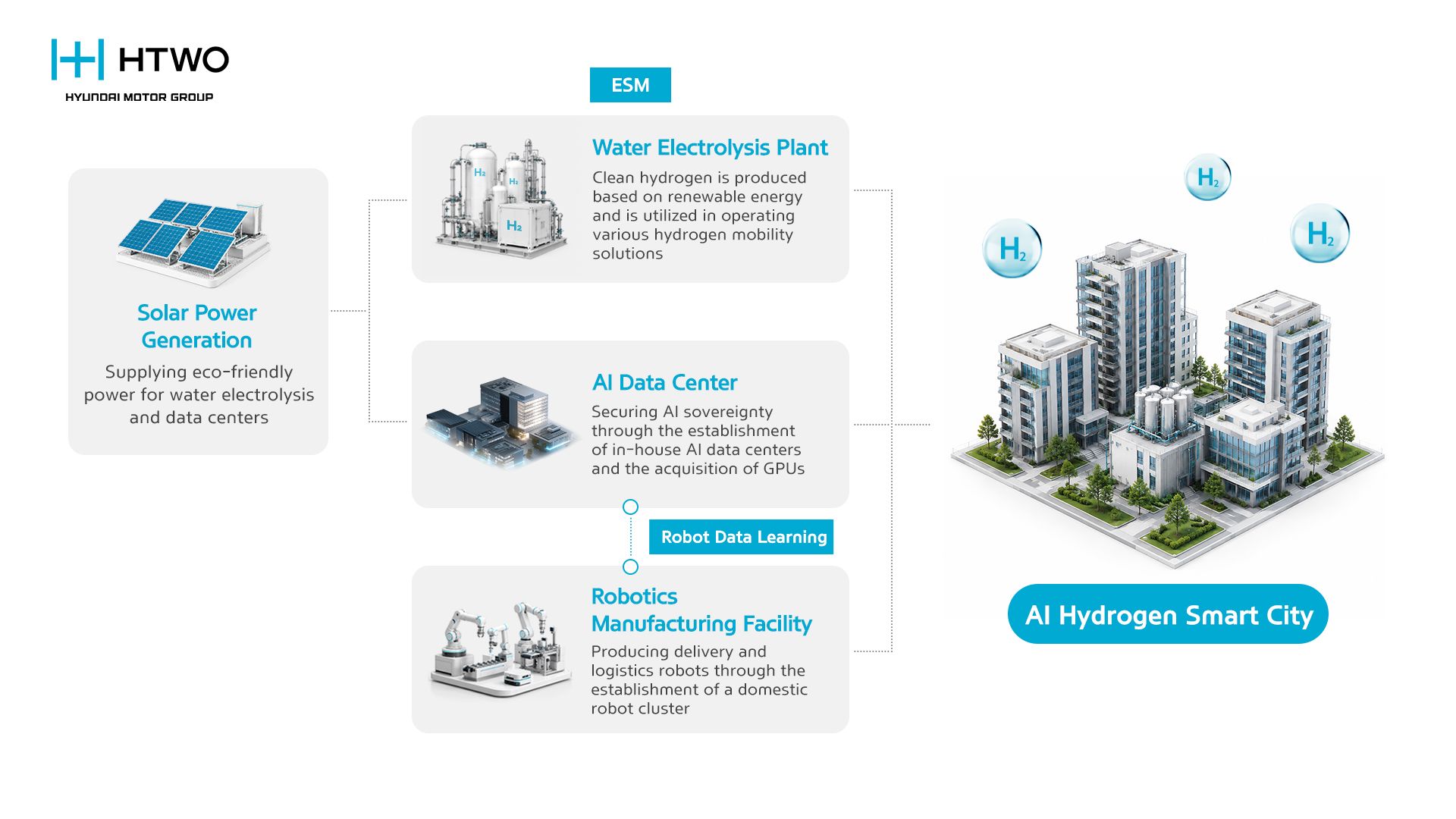
A defining feature of the Saemangeum AI Hydrogen City is its localized energy system, in which energy produced in the region is also consumed there. By connecting energy production, storage, supply and utilization in one area, the system is designed to reduce reliance on external sources and strengthen regional energy self-sufficiency.
Clean electricity from Saemangeum’s solar facilities will power the AI data center and robotics manufacturing facilities, while also producing clean hydrogen at the water electrolysis plant. The hydrogen produced will be supplied to urban power generation facilities, industrial sites and hydrogen mobility applications, helping balance electricity demand with renewable energy generation.
This circular structure converts solar-generated electricity into hydrogen, uses hydrogen to power cities and industries, and, when needed, converts it back into electricity. Hyundai plans to connect the entire hydrogen value chain—from production to supply and utilization — in Saemangeum, creating an ecosystem in which clean energy circulates within the region.
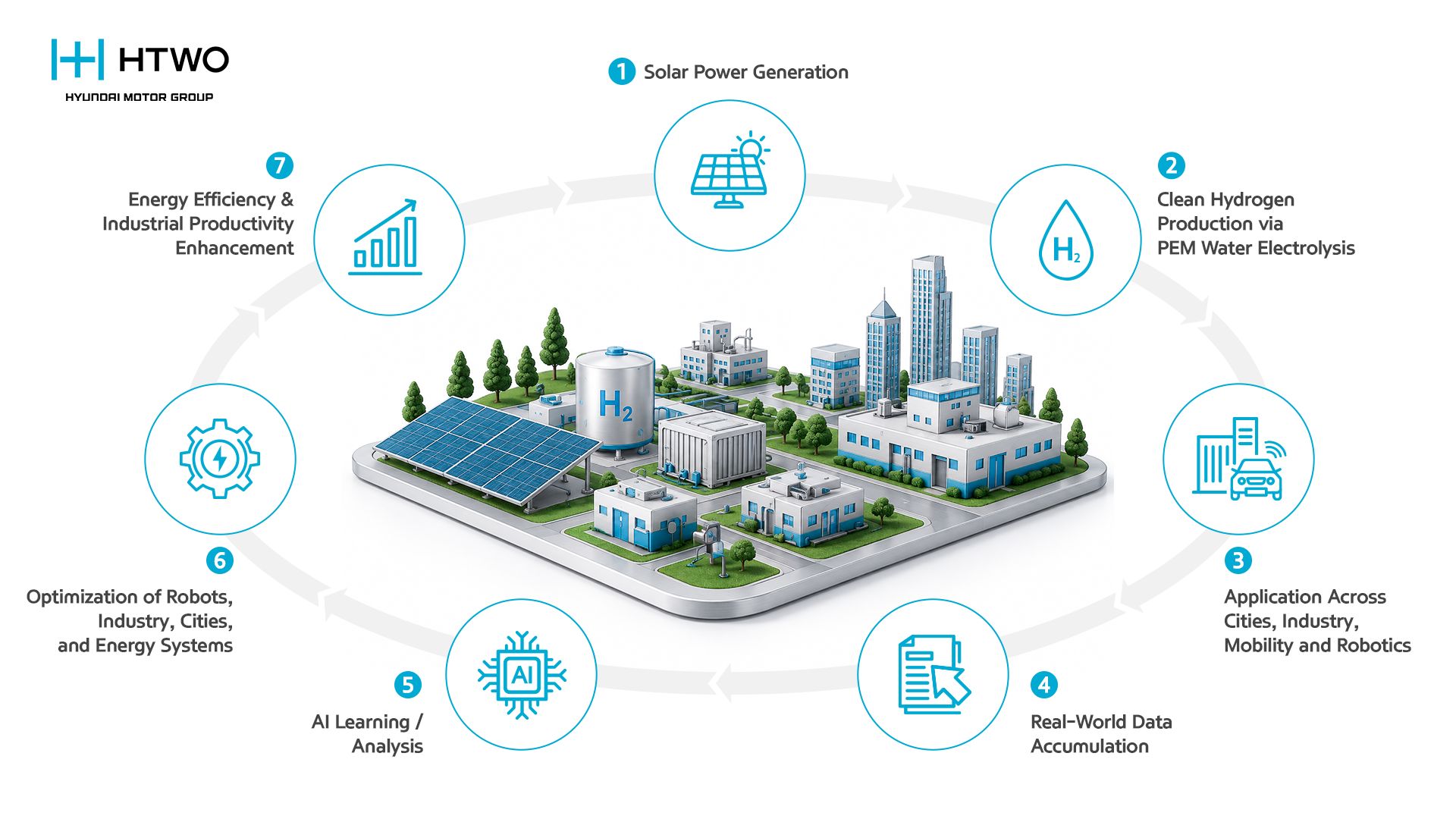
Saemangeum AI Valley builds on its localized energy system by combining AI and robotics with a hydrogen-centered energy ecosystem. The project aims to create a self-sustaining, circular ecosystem that improves the operational efficiency of the city and its industries.
Solar-generated electricity and clean hydrogen will support robotics manufacturing facilities, the AI data center, mobility solutions and urban infrastructure. Their operations will generate data on robot performance, manufacturing processes, mobility and urban energy demand. The AI data center will analyze this data, and the resulting AI capabilities will be applied across robots, industrial facilities, mobility solutions and urban infrastructure to improve productivity, safety and energy efficiency.
Saemangeum AI Valley expands on the hydrogen city and ecosystem initiatives Hyundai is advancing across Korea, using Hyundai’s experience in establishing hydrogen value chains in Jeonbuk State, Jeju, Cheongju, Pyeongtaek and Ulsan. It represents an evolution of Hyundai’s hydrogen business, extending the hydrogen ecosystem into AI and robotics industries.
※ Hyundai Motor Group’s Hydrogen City Development Projects in Korea
The Korean government is expanding infrastructure for hydrogen production, distribution, power generation and mobility, aiming to establish an annual hydrogen supply and demand system of 3.9 million metric tons by 2030. The Ministry of Land, Infrastructure and Transport currently supports 15 Hydrogen Cities and one Hydrogen Demonstration City nationwide. In 2026, central and local governments allocated KRW 1.27 trillion to accelerate hydrogen mobility, including fuel cell electric vehicle deployment, fuel costs and refueling infrastructure.
• Cheongju Hydrogen City: Cheongju is home to HTWO ENERGY Cheongju, the first Group-operated integrated waste-to-hydrogen (W2H) production and refueling facility. It uses biogas generated from sewage sludge to produce hydrogen for mobility applications in Cheongju and North Chungcheong Province, helping enhance regional energy self-sufficiency.
• Pyeongtaek Hydrogen City: Pyeongtaek is developing a hydrogen city focused on port and logistics applications. Since November 2024, Hyundai has been conducting Korea’s first pilot operation of a fuel cell electric car transporter on the approximately 40-km round-trip route between Hyundai Motor Company’s Asan Plant and Pyeongtaek Port. Hyundai is also advancing fuel cell power generator installation at facilities operated by Kia, Hyundai Glovis and Pyeongtaek International Automobile Terminal (PIRT). These initiatives use hydrogen produced near Pyeongtaek Port across port logistics equipment and mobility applications.
• Ulsan Hydrogen City: Ulsan is Korea’s largest hydrogen city, accounting for approximately 50 percent of the country’s hydrogen production. Building on its automotive, shipbuilding and petrochemical sectors, the city is developing a hydrogen production and utilization ecosystem. Hyundai is contributing through fuel cell electric tram and truck demonstrations and fuel cell production infrastructure. Hyundai Motor Company’s new hydrogen fuel cell production facility in Ulsan is scheduled for completion in 2027.
※ Hyundai Motor Group’s Hydrogen Ecosystem Development Projects in Korea
Hyundai is working with major regions including Jeonbuk State, Jeju Special Self-Governing Province, Cheongju, Pyeongtaek and Ulsan to build hydrogen ecosystem models tailored to each region’s energy resources and industrial characteristics.
• Jeonbuk State Hydrogen Ecosystem: Hyundai has worked with Jeonbuk State to create a hydrogen ecosystem centered on Hyundai Motor Company’s Jeonju Plant, linking the production, refueling and operation of hydrogen-powered commercial vehicles. In 2020, Hyundai launched the world’s first mass-production system for hydrogen-powered commercial vehicles and Korea’s first commercial vehicle hydrogen refueling station at the plant. Fuel cell electric buses also began operating on Jeonju city routes. Hyundai continues to expand hydrogen mobility applications to city, regional and express buses, cleaning trucks, heavy-duty trucks and forklifts. In Saemangeum, it is advancing an industrial ecosystem that connects hydrogen with AI and robotics through the development of advanced robotics and hydrogen industries and the creation of an AI Hydrogen City.
• Jeju Hydrogen Ecosystem: Leveraging Jeju’s renewable energy resources, including wind and solar power, Hyundai is advancing a green hydrogen production demonstration project based on 5 MW-class PEM water electrolysis. The project converts surplus electricity generated during renewable energy curtailment into hydrogen for mobility applications, contributing to a renewable energy-based green hydrogen ecosystem.
As Hyundai brings together its hydrogen technologies, manufacturing expertise and AI and robotics capabilities with government policy and infrastructure support, a new ecosystem is taking shape that connects energy and advanced industries around hydrogen. Saemangeum AI Valley is expected to strengthen Korea’s hydrogen industry competitiveness and demonstrate the potential of public-private collaboration in fostering future industries.